Someone ran custom code on the Nintendo Switch 2 on October 22. There will be plenty of articles this week on how it works. I'm more interested in what it says about people, so this one is about that.
I've never been curious about jailbreaking a console. I pay for my games, and if there's a deal, even better. That's how I've always done it. Still, I understand why people go the other way, and I'd like to explain why.
What a jailbreak is, in plain words
A game console is a computer that only runs software its maker has approved. Nintendo checks every game and app, and the console refuses to start anything that hasn't passed. That's the lock.
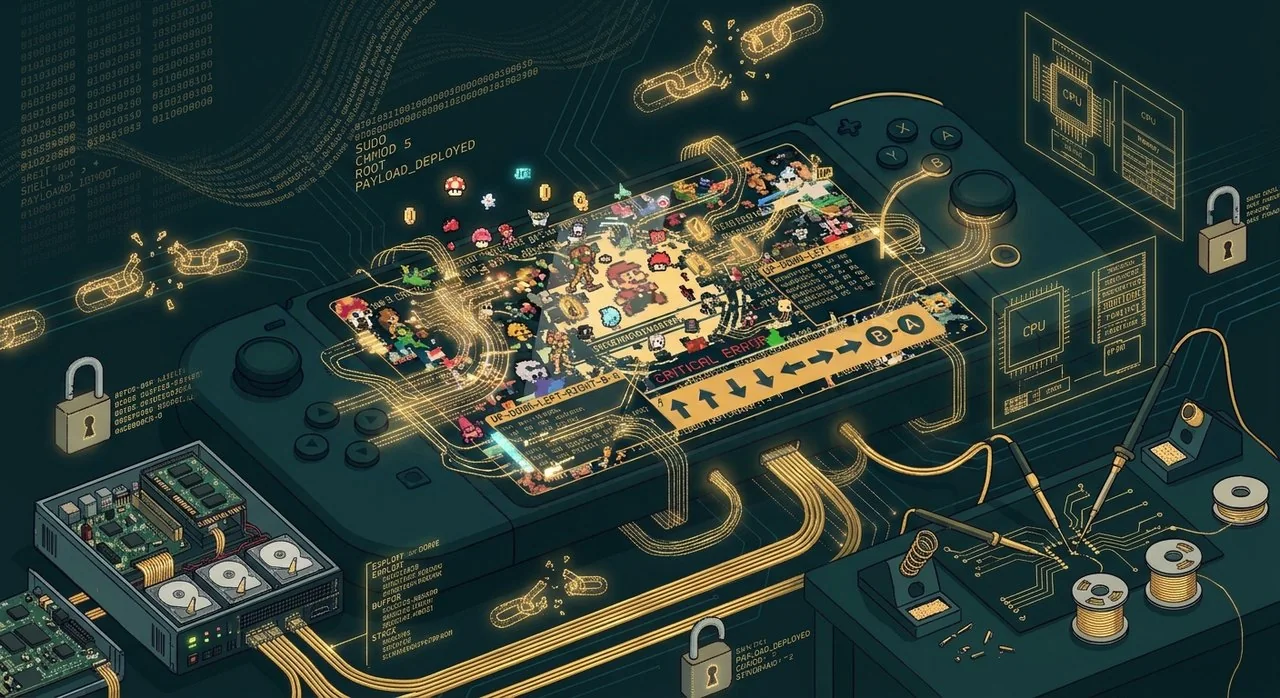
A jailbreak gets around it. Programs are written by people, so they contain mistakes, and some mistakes let a program do something its makers never planned. Someone finds one, usually in a game or an app, and feeds it carefully prepared data until the console ends up running the person's own code. The trick that does this is called an exploit.
Once your own code runs, you can go further: start programs made by fans, which is called homebrew, change a game, or back up your saves. A full jailbreak installs a modified system, called custom firmware, that does this every time the console starts. A smaller one only lasts until the next restart.
It breaks the console maker's rules, and it can make piracy possible, which is a big reason companies fight it.
What happened on October 22
The developer is Sammy Hajhamid, who goes by pepsipu. He calls his jailbreak ns2jb and says it works on Switch 2 system version 23.0.1. As far as he knows, it's the first exploit for the Switch 2. Reports say the way in is a Switch 1 game called SmileBASIC 4, a program for writing your own games, plus a second flaw in the Switch 2 itself.
It's tethered, which means it has to be run again every time the console restarts. It doesn't install custom firmware and it doesn't give full control of the console. His own write-up says only one built-in part of the system has been compromised so far. The demo that went around was Mario Kart World with extra characters like Hatsune Miku and Peter Griffin.
People have always opened things to see how they work
4ru4k told me he used to open up his Game Boy as a kid, just to see what it looked like inside and how it worked. I think most of us know someone like that. A jailbreak is the same urge on a bigger machine. Some people do it out of curiosity and some for the thrill of getting into a place the manufacturer closed.
pepsipu's write-up reads that way too. He talks about homebrew, mods, save backups and research, and he doesn't address piracy.
The way in has often been the playful part
Looking back through Nintendo's history, the door is often a part of a game where players bring their own things in.
In 2008, hackers used a corrupted save file in The Legend of Zelda: Twilight Princess to run their own code on the Wii and install the Homebrew Channel, an app that lets a Wii start programs made by fans. In November 2014, the first public homebrew exploit for the 3DS came through Cubic Ninja and its level-sharing feature, which worked with QR codes. Now the Switch 2 has been opened through a programming app.
Nintendo builds spaces for players to make things and share them, and those spaces are where people keep getting in. It doesn't happen every time. In April 2018, researchers disclosed a flaw in the original Switch's chip, and it couldn't be patched on the consoles already sold, about 14.8 million at the time.
Nintendo has answered the same way for decades
The answer has been patches, bans and lawsuits.
In 1990, Nintendo went to court to stop the Game Genie, a gadget that changed what an NES game did while it ran. It lost, and in 1992 the appeals court sided with the maker. From 2007, Nintendo went after sellers of DS flash cartridges in many countries, and the courts didn't agree with each other. A French court dismissed Nintendo's case in 2009, partly because the cards could also run homebrew, and an appeals court reversed that in 2011. In Italy, one court ruled flash cartridges legal in 2016 and another sided with Nintendo in 2017. In 2022, Gary Bowser, who handled public relations for Team Xecuter, a group that sold Switch hacking tools, was sentenced to 40 months in prison.
Today, Nintendo's user agreement says that bypassing its protections may leave a device "permanently unusable in whole or in part." In September 2026, some Switch 2 owners reported losing access to online services with error 2124-4508. Nintendo gave no statement, the cause isn't clear, and some owners say they were unbanned.
Nintendo can close software holes with an update, and it has done so before. It patched the Wii's BannerBomb exploit in firmware 4.3. A flaw in the hardware is another matter, as 2018 showed. ns2jb is software, so I'll be watching for a flaw deeper than that.
Paying for something and not owning it
I also understand the anger of people who paid for something, thought it was theirs, and then found out the company can do whatever it wants. Nobody asked their opinion. Games are expensive, and it's hard for many people to get access to all of them.
It has happened before. The PS3 could run other operating systems, such as Linux, and some people bought one for that. Sony removed the feature with a firmware update in April 2010 and cited security concerns. A class action followed, and hackers brought the feature back with modified firmware.
Nintendo has a version of it too. In late March 2023, purchases ended on the Wii U and 3DS eShops. Nintendo said people could still redownload their games for "the foreseeable future," and that it had "no plans to offer classic content in other ways" beyond Nintendo Switch Online.
Sony is in the same conversation this year. On July 1, it announced it will stop making discs for new PlayStation games from January 2028. In August, in a US court filing, it argued that no reasonable consumer believes a "Buy Now" button on a digital game means ownership. A public PS5 jailbreak was reported on September 29. Some sites called the interest in it a protest, but I looked for proof and it's thin. Decrypt found no organized protest. I can't call it one. I can say it all happened in the same season.
Why I'd keep my console closed
For me, a Switch 2 is a beautiful object, and jailbreaking it feels like putting dirt on it. I'm just not into it. I understand the curiosity, the thrill of getting in, and the anger of people who feel that what they paid for isn't really theirs.
What I'm watching next
- Whether Nintendo answers with a statement or a patch. pepsipu guesses that Nintendo may move toward encrypted code loading, and notes that it has already started removing dynamic code features.
- Whether a flaw shows up that an update can't fix.