Nintendo has taken some of the people who opened its consoles to court and left others alone for years. Going through the cases from 1988 to today, the difference I keep finding is whether what they made lets people skip paying for games. Part 1 covers why people open consoles in the first place.
1988: Atari wanted to publish without Nintendo
Atari Games wanted to sell NES games without going through Nintendo, and a lock chip was in the way.
The lock
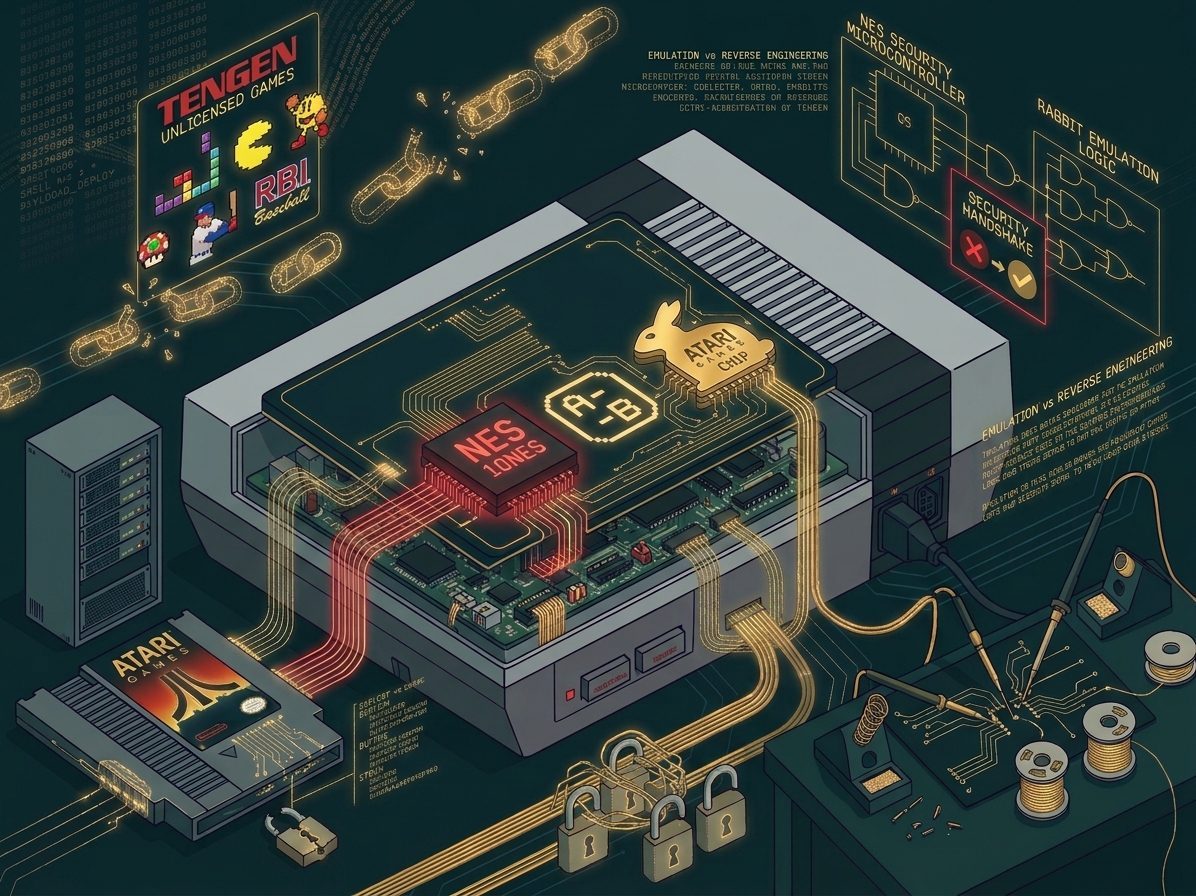
The NES reached North America in 1985, a couple of years after the video game market crashed. Every NES had a lock chip called the 10NES, and every licensed cartridge had a matching key chip. A cartridge without the key wouldn't start. Nintendo also made the licensed cartridges itself: developers sent in their code, and Nintendo added the key and sent back the finished cartridge. The lock decided who could publish for the console.
Atari had formed a subsidiary, Tengen, in 1986, and it became an official licensee in 1987 with two years of exclusivity on its games. It still wanted out of Nintendo's terms. Its engineers tried to read the chip by watching its signals and peeling away its layers. That didn't work.
The application
In 1988 Atari's lawyers told the Copyright Office that Nintendo was suing Atari and asked for a copy of the sealed lock code to use in that case, although no case existed. The Office released the copy and Atari used it to build its own chip, which it called the Rabbit. Tengen cartridges started booting on the NES, among them its versions of Tetris, Super Sprint and Ms. Pac-Man.
The lawsuits
Atari sued Nintendo in December 1988 over antitrust and unfair competition. Nintendo countersued in November 1989 and pointed at the Copyright Office application. The district court found that Atari had obtained the code under false pretenses and gave Nintendo a preliminary injunction against Atari selling unlicensed NES games, and on September 10, 1992 a federal appeals court upheld it.
The judges also wrote that reverse engineering can count as fair use. Atari lost because it had built its chip from the code it got through the false application, and a court won't help a party that comes in with dirty hands. A month later, in a case about Sega's console, a different appeals court sided with a company called Accolade, which had reverse engineered Sega's lock in 1991 for its game Ishido. The two rulings refer to each other.
What happened to Atari
Atari Games was barred from making NES games, and the two companies settled in 1994 with Atari paying damages and license fees. Tengen's Tetris was recalled and is now an expensive collector's item. Atari designer Ed Logg later said Nintendo had "bled Atari to death." The Tengen name came back in 2024 with a new NES homebrew game, Zed and Zee. Popular Science notes that the rulings from this period still protect emulators.
1990: The Game Genie changed a game people already owned
The Game Genie is the case Nintendo lost. The device changed a game people had already bought and didn't copy it.
Codemasters and Galoob
Codemasters was founded in 1986 by two British brothers, Richard and David Darling, and started out making budget games for home computers. Its team had put switches on its own NES cartridges to change things like lives and weapons, and the Game Genie grew out of that: a gadget that sat between the cartridge and the console and changed what the game did while it ran. Codemasters reportedly got a cold reception from Nintendo at a Las Vegas trade show, and it bought every NES game it could find to document the codes. Lewis Galoob Toys, an American toy company, sold it in North America. One account says Galoob's owner took it on because his son wanted Mario to jump higher, but I couldn't confirm that.
The injunction
Galoob and Codemasters sued Nintendo first, on May 17, 1990, asking a court to declare the Game Genie legal. Nintendo asked for its own injunction and a judge granted it on July 2, 1990, which kept the device off U.S. shelves. Nintendo had to post a bond to cover Galoob's losses in case the ruling turned out to be wrong. It started at 100,000 dollars and was raised to 15 million. An appeals court kept the injunction in place in February 1991.
Canada went differently. Nintendo's case against Camerica, the Canadian company that handled Codemasters' games, was dismissed that same month, so the Genie was on sale in Canada while it was blocked in the U.S.
The trial and the bond
On July 12, 1991, Judge Fern Smith ruled for Galoob. She compared using the Game Genie to skipping chapters of a book or fast-forwarding a movie, and said a person who has paid for a game can experiment with it at home. The injunction had lasted just over a year and was lifted.
At a hearing in December 1991 the court used sales data from Canada to estimate what the ban had cost Galoob, found the losses went past 15 million dollars, and gave Galoob the whole bond plus legal fees. In May 1992 the Ninth Circuit confirmed the ruling. The Genie's changes weren't permanent, so it created no new version of the game, and Nintendo hadn't shown any harm, since buyers still needed the original game to use it. Nintendo's appeal against the damages failed too.
After the ruling
The Game Genie sold in huge numbers, and one article puts it at a business worth roughly 140 million dollars. The ruling is still cited in cases about game mods. David and Richard Darling were made Commanders of the Order of the British Empire in 2008.
I used cheat codes in The Sims as a kid, and the Game Genie is the same idea on the NES: a code that changes a game you already own. These days I look for games that are easy on a tired brain without any codes, and the ones I'd pick are on our page of the best games to play after work.
Camerica and the switch on the back
Camerica sold unlicensed cartridges with a switch on the back that turned off the NES lock chip, which could damage some consoles. It hired a former Nintendo champion, Thor Aackerlund, as its spokesman and sold products on the Home Shopping Network. The Game Genie lawsuit delayed its game The Fantastic Adventures of Dizzy until April 1991, and the game sold about 125,000 copies instead of the 500,000 expected. Camerica's Aladdin Deck Enhancer cost 40 dollars plus 20 per game, had shipping problems and offered no real enhancements, and the company collapsed around 1993.
1997: The Doctor V64 copied Nintendo 64 games
Nintendo's first lawsuit over the Doctor V64 described it as a device that copies games.
A copier from Hong Kong
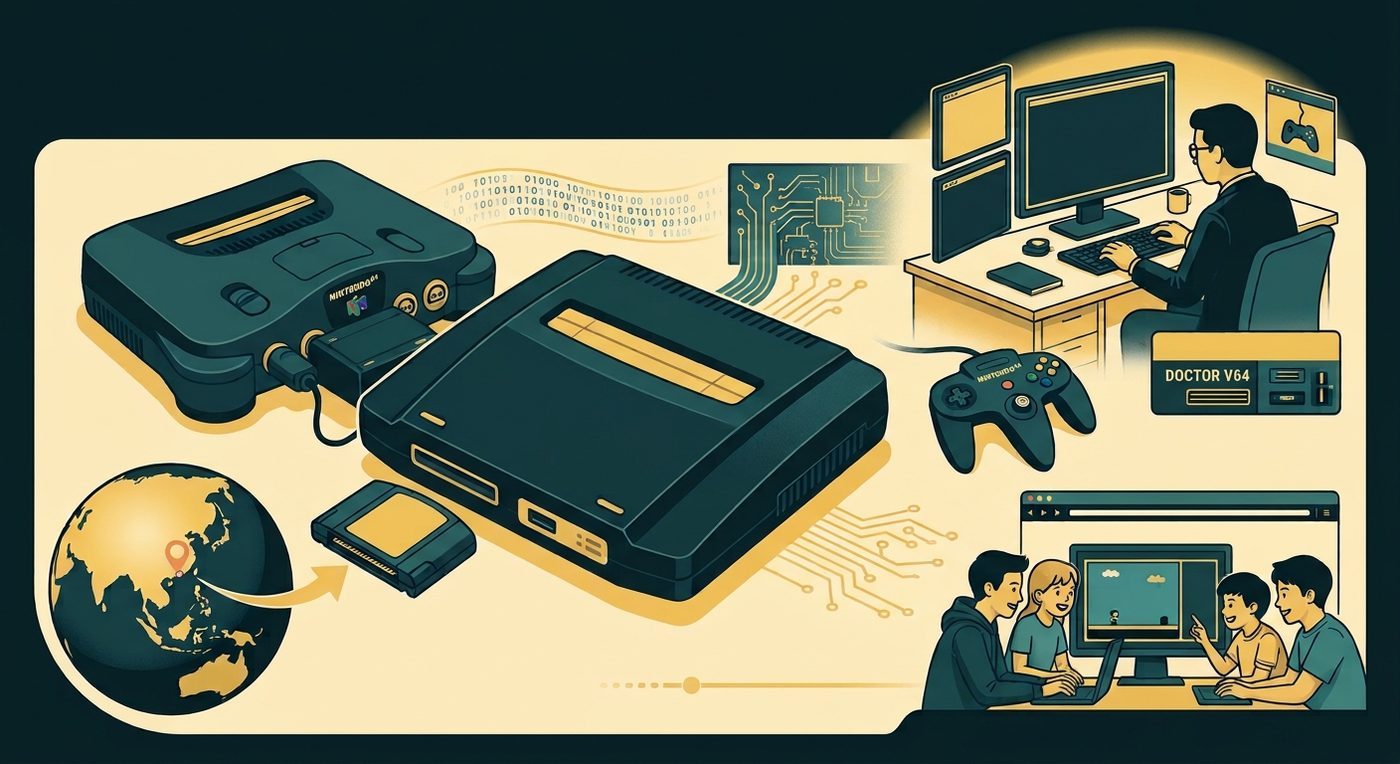
Bung Enterprises made game copiers for the NES, Super NES, Genesis, Game Boy and more, and it was barely known in the West until the late 1990s. In 1997 it released the Doctor V64, the first Nintendo 64 copier you could buy. Official Nintendo development hardware was hard to get, so small developers bought Bung's boxes to build and test their own games, and Bung sponsored a coding contest for amateur programmers.
Nintendo's lawsuits
In November 1997 Nintendo sued Bung and a Florida distributor, Carl Industries, in federal court in Los Angeles. The suit described the Doctor V64 as a device that copies Nintendo 64 games to writable CDs or a PC hard drive and plays the copies, and Nintendo said counterfeit products had cost it and its publishers about 810 million dollars in worldwide sales the year before. A California store had already settled, and the U.S. retailers agreed to stop selling the device. In Europe, Nintendo reported that the products lacked CE certification, and Bung got its power adapters certified and kept selling. Nintendo then sued Bung in Hong Kong.
The company that came back
The owners dissolved Bung in March 2000 and a few months later started First Union Technology, which sold similar products under the name Mr. Flash. U.S. Customs began seizing shipments, which ended direct sales to American buyers.
Nintendo then went after the Hong Kong retailer Lik Sang. In February 2002 U.S. Customs intercepted a shipment that turned out to be a harmless serial cable. In October 2002 Nintendo, Sony and Microsoft sued Lik Sang together, and the shop closed for two weeks and reopened without the disputed products.
2007: The R4 ran copied games and homebrew
The R4 could do both, and the courts spent years arguing over which one counted.
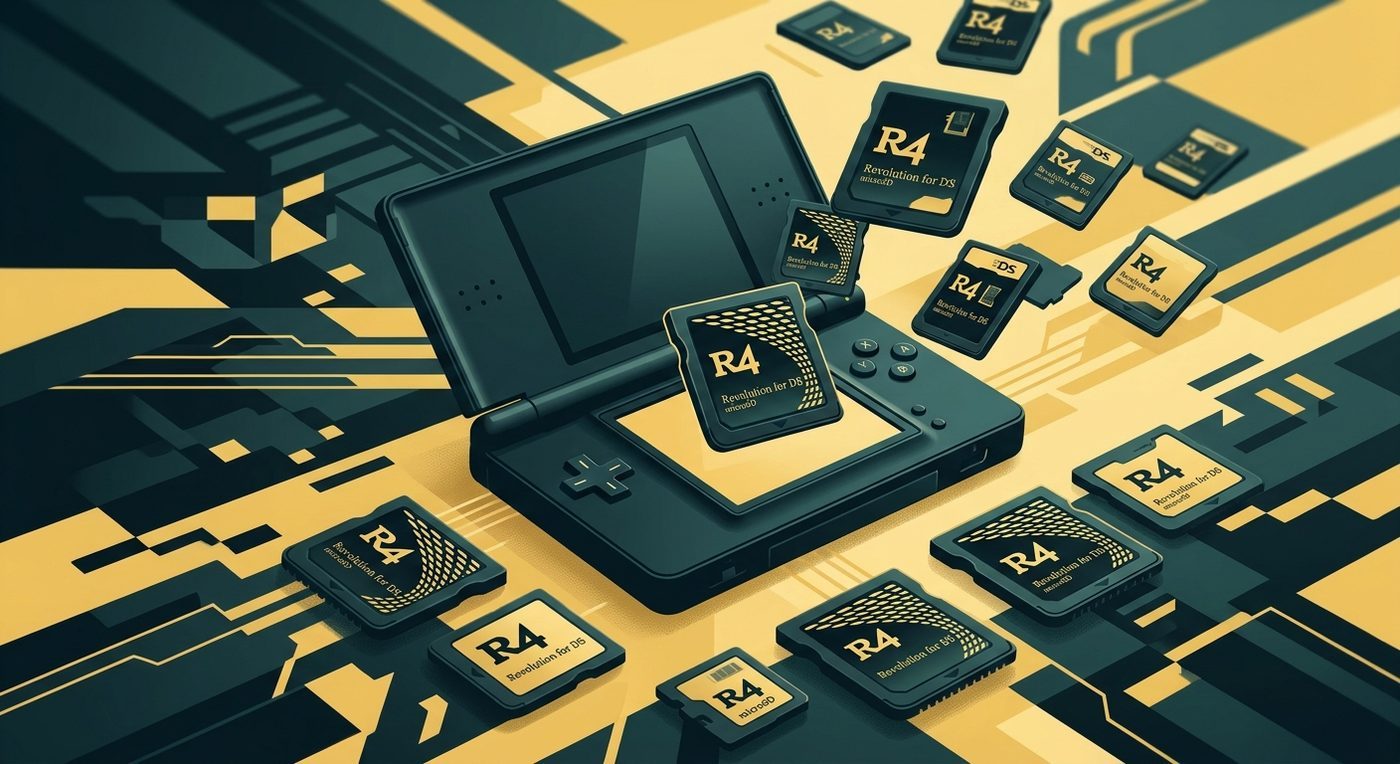
The card
By 2007 the DS was everywhere, and a product called the R4 let people load games from a microSD card. The R4 Team released the original "Revolution for DS" that year. Other sellers soon put the R4 name on their own cards, and when the original team stopped production, clones kept coming.
The raids and lawsuits
Nintendo said that by July 2008 it had worked with officials in 11 countries over the previous year, Spain among them, and had seized close to 30,000 copying devices. That same month, Nintendo and 54 game companies took five importers and sellers to a Tokyo court. By 2009 Nintendo said around 100,000 devices had been seized, and Japan outlawed R4 sales that year.
Country by country
The courts didn't agree with each other.
- In the UK, a High Court judge ruled against the importer Playables Limited in July 2010, even though its defense argued that the cards could run homebrew.
- In France, a case against sellers was dismissed in 2009. An appeals court overturned that in October 2011 and fined five sellers and distributors more than 460,000 euros in total, and some people were jailed.
- In Japan in 2013, a court ordered two distributors to pay Nintendo and 49 other developers 95,625,000 yen.
- Germany made flash cards illegal in December 2014, and a seller was fined over 1 million euros. Private use is not illegal there, but using pirated software is.
- In Italy in 2016, a court in Catania ruled the cards legal, partly because the R4 can't run copyrighted code without software that isn't sold with it. In 2017 Italy's highest court sided with Nintendo in another case.
- Australia, Belgium, the Netherlands and South Korea also banned them.
The original R4 is gone, but clones with the same hardware still sell online.
2007: The Wii team said it was against piracy
The group that opened the Wii said it opposed piracy and didn't profit from its work, and I found no Nintendo lawsuit against it. Nintendo patched.
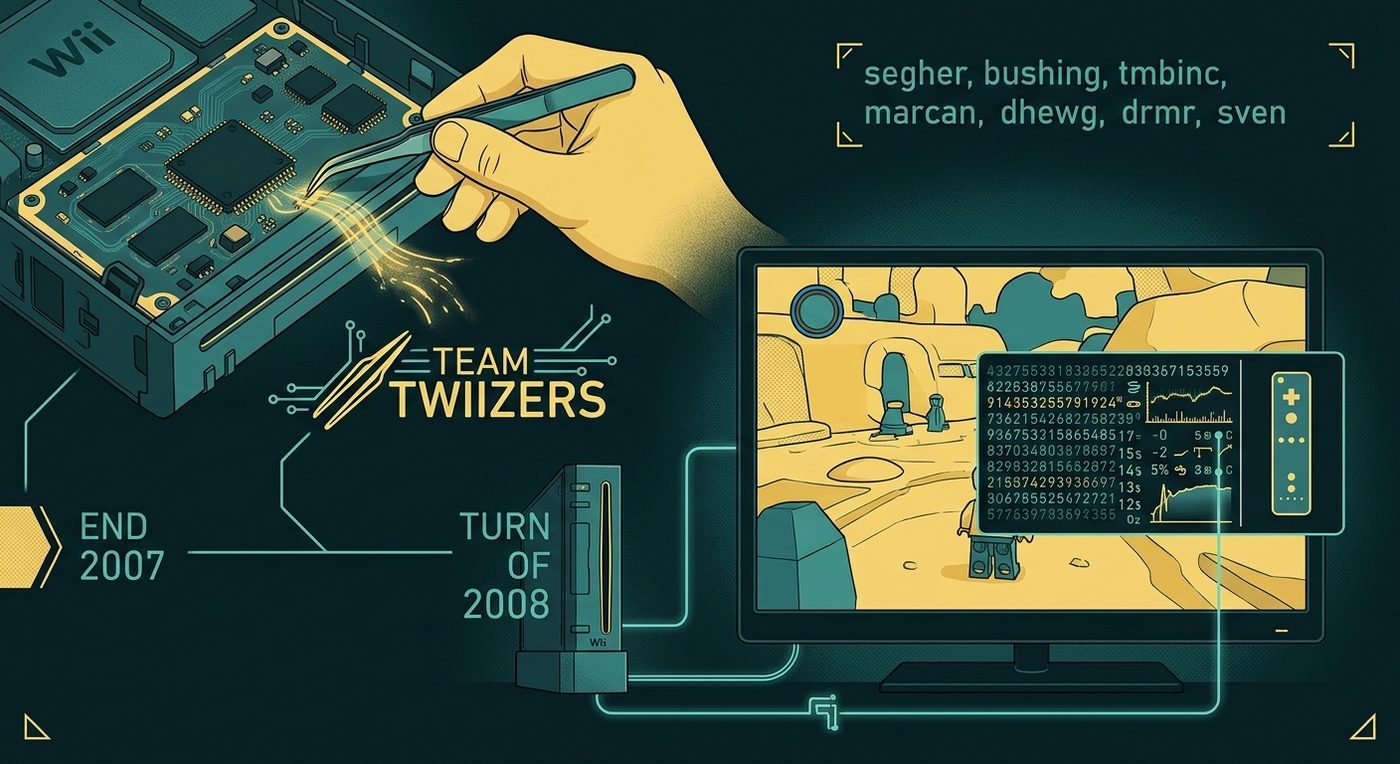
Team Twiizers
The Wii was first opened at the end of 2007, when a group of hackers used a pair of tweezers to bridge two points on its memory and reach parts of the system Nintendo had locked. They named themselves Team Twiizers after the trick. The members went by the handles segher, bushing, tmbinc, marcan, dhewg, drmr and sven. Around the turn of 2008, bushing showed a modified copy of Lego Star Wars that displayed Wii Remote data live.
The Twilight Hack
The Twilight Hack followed in early 2008. It was a modified save file for The Legend of Zelda: Twilight Princess, with a horse name far too long for the game to handle, and it made the console run the hackers' own code from an SD card. That led to the Homebrew Channel, a fan-made app that became the Wii's gateway to homebrew, whose first full release came in December 2008.
The group says it opposes piracy and doesn't profit from its work, and that donations only paid for bandwidth. It held back some exploit details and code so pirates couldn't use them and Nintendo wouldn't learn what to patch, which annoyed parts of the community.
Update 3.3
Nintendo's answer came in June 2008. Wii system update 3.3 contained code that looked for the Twilight Hack, and it also blocked a tool called Freeloader that let people play imported games. Engadget reported on June 18, 2008 that Nintendo's repair service was installing the update on Wiis it fixed, so people who sent in broken consoles got them back with the hack disabled. A thread on the GBAtemp forum was titled "CURSE u NINTENDO!" The update didn't appear to affect the Homebrew Channel on consoles that already had it.
New exploits kept arriving: LetterBomb through the Message Board, one through the stage editor in Super Smash Bros. Brawl, one through the Internet Channel. Nintendo patched BannerBomb in firmware 4.3. BlueBomb later made the Wii Mini hackable, a model many people had written off because it has no SD slot or internet connection.
What the team did next
The team renamed itself fail0verflow. One of its members, Hector Martin (marcan), reverse engineered Microsoft's Kinect in 2010 and wrote the first open-source driver for it. Sony sued him and others over PlayStation 3 hacking, and the case was settled out of court. He put Linux on the PlayStation 4 in 2016, founded Asahi Linux in 2021 to run Linux on Apple's M1 Macs, and stepped away from that project in February 2025.
2014: Cubic Ninja only ran homebrew
Jordan Rabet said his 3DS exploit couldn't run unlicensed games, and Nintendo answered with patches and, later, a bounty program.
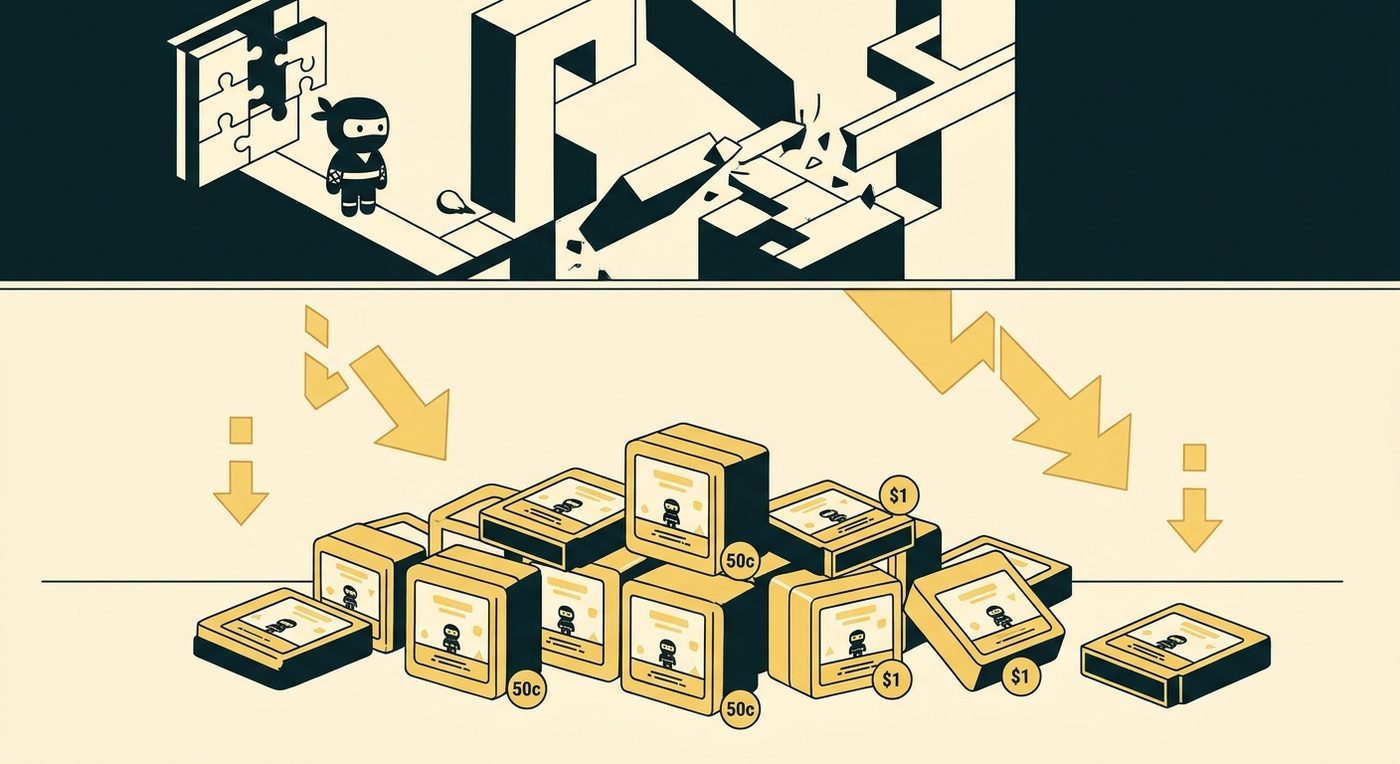
The game
Cubic Ninja is a 2011 3DS puzzle game by AQ Interactive, published outside Japan by Ubisoft. Reviews were mixed, with a Metacritic score of 51, because of the tilt controls, the frustrating levels and the short length. Used copies sold for under a dollar.
The release
Rabet, who goes by smealum, found a way in through the game's level sharing feature, which uses QR codes. He planned to release the exploit, called Ninjhax, on August 30, 2014. After Nintendo unveiled the New 3DS he postponed it, to give Nintendo less time to patch it before the new console arrived. He published it in mid-November 2014, timed to the New 3DS launch in Australia and New Zealand. The sources I found give dates between November 17 and 21. It was the first public software exploit that let all 3DS models run homebrew.
The price spike
Once the name of the game got out, used copies went from bargain bin prices to around 40 to 70 dollars, and resale prices reached as high as 500 dollars at the peak, against an original price of 40 dollars. Copies sold out at big retailers, and Nintendo removed the game from the Japanese eShop, where it had been sold digitally. Rabet pointed out that AQ Interactive disappeared only months after the game's release, in a merger that created Marvelous AQL.
Patches and a bug bounty
Ninjhax 2.0 arrived in July 2015. In May 2016, system update 11.0 broke the original by cutting Cubic Ninja's access to web services, and by September 2016 there was a workaround that needed several QR codes.
On December 8, 2016, Nintendo announced a bug bounty through the service HackerOne, paying between about 100 and 20,000 dollars for 3DS bugs. Researchers had to be the first to report a bug and had to agree not to share it with anyone else. In April 2017 the program was extended to the Switch, and at least three bounties had been paid by then. The 3DS eShop closed to purchases in late March 2023.
2016: The NES Classic
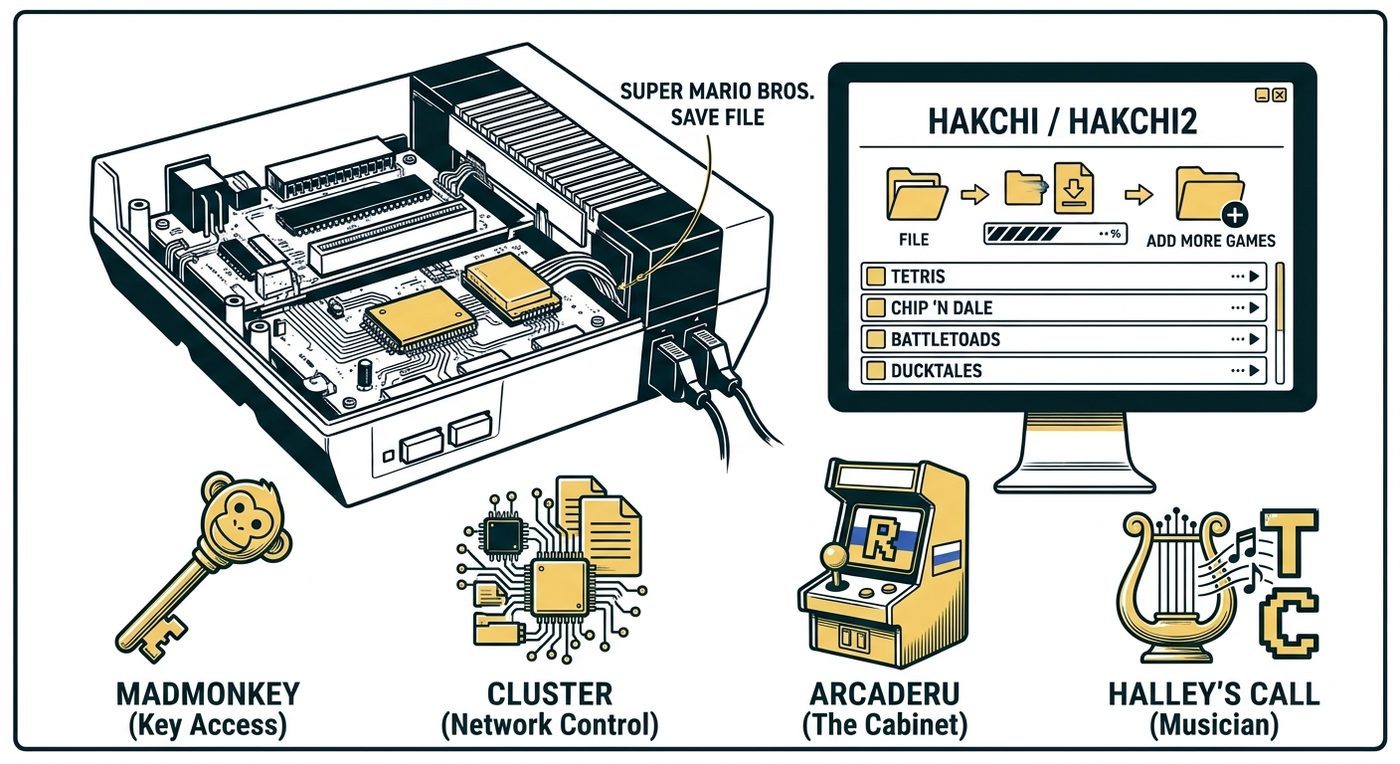
Nintendo's NES Classic Edition arrived with 30 games built in, and hackers had it open within a couple of months. In early January 2017 a person with the handle madmonkey posted a guide on a Russian forum and made a tool called hakchi, which let owners add more games to the little console. A second developer, Cluster, followed with hakchi2, which made it drag and drop. The first method needed a particular Super Mario Bros. save file. A Russian arcade cabinet builder who goes by ARCADERU posted videos of the results, and the video game musician Halley's Call tried it and added Tetris, Chip 'n Dale, Battletoads and DuckTales.
Some antivirus programs flagged the tools as viruses, and the developers and others believed these were false alarms. I couldn't find a reaction from Nintendo. The U.S. government later listed the NES Classic among the consoles Team Xecuter targeted.
2018: Two free tools and one paid one for the Switch
The Switch got two free tools for homebrew in 2018 and, soon after, a paid one that prosecutors later called a piracy scheme.
Two teams, one flaw
The Switch had been out for just over a year when Katherine Temkin of the group ReSwitched published a flaw she called Fusée Gelée, a bug in the Nvidia Tegra chip inside the console. She had planned a full disclosure in June. She published in April 2018 instead, after Team Xecuter signaled that it was weeks away from a similar exploit and she wanted hers to be first. BleepingComputer described it as a race for fame. Shortly after, fail0verflow, the same crew from the Wii days, published its own version for the same bug, which it named ShofEL2.
The two teams had different tones. Fail0verflow said it worked "for fun and homebrew, and nothing else." Its FAQ admitted that it had already damaged one LCD screen with faulty code and wouldn't be responsible if a Switch caught fire, and it showed Linux and the Dolphin emulator running on the console. Temkin said she passed the flaw to Nvidia first and then to several companies including Nintendo as a courtesy, and that Fusée Gelée "isn't a perfect, 'holy grail' exploit" but can be "pretty damned close" in some cases.
Nintendo's answer
The flaw sits in the chip's permanent startup code, which is locked at the hardware level, so a software update can't fix it. On July 10, 2018, the hacker SciresM wrote that new Switch units seemed to be protected. The fix had to be made at the factory, so every console already sold stayed open. About 18 million Switches had been sold by then, according to a French report on his post.
2020: Team Xecuter sold the tools
Team Xecuter is the case where prosecutors put a number on the games people skipped paying for: more than 65 million dollars.
The group
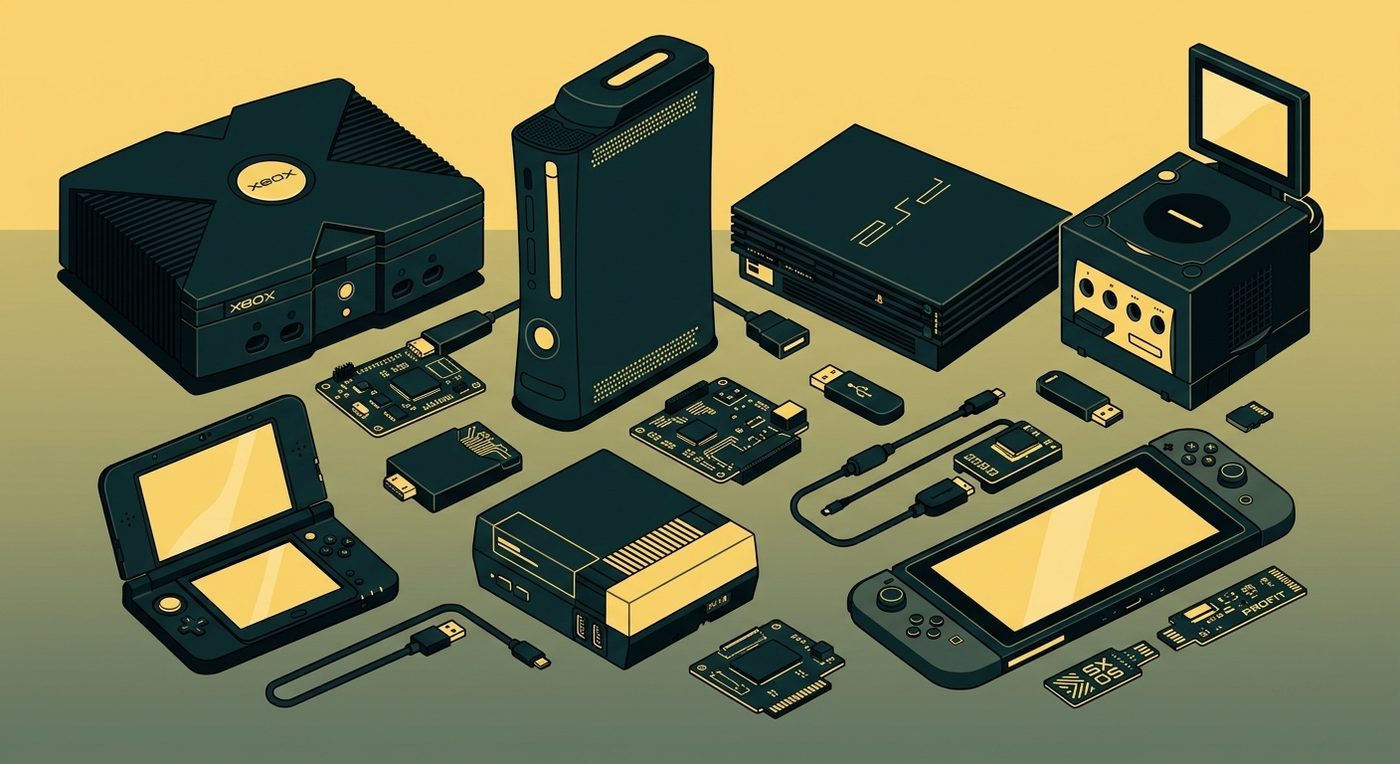
Team Xecuter had been around since at least 2013 and sold tools for hacking the Switch, 3DS, GameCube, NES Classic, PlayStation and Xbox. It sold its Switch custom firmware, SX OS, for profit, and many hobbyists disliked that.
The indictment and three arrests
On August 20, 2020 a federal grand jury in Seattle indicted three of its people, Gary Bowser, Max Louarn and Yuanning Chen, each on 11 felony counts including wire fraud conspiracy, trafficking in circumvention devices and money laundering conspiracy. The three cases went differently.
- Gary Bowser, a Canadian living in Santo Domingo in the Dominican Republic, was arrested in September 2020 and sent to the U.S.
- Max Louarn, a French national from Avignon, was detained in Tanzania at the request of U.S. authorities. On October 16, 2020 a court in Dar es Salaam dismissed the extradition request and ruled the arrest illegal. He flew by private jet to the island of Réunion and then to mainland France, which doesn't extradite its own citizens.
- Yuanning Chen, a Chinese national from Shenzhen, was never in U.S. custody.
Gary Bowser
Bowser wasn't the technical mind. He was the group's public face, known online as GaryOPA, answering customers and running the websites, and one report says he was paid 500 to 1,000 dollars a month. In an interview he said, "I can handle people, and that's why I ended up getting more involved." An FBI official called him the "voice and public face" of the group.
He pleaded guilty in October 2021 to two counts, and the other nine were dropped. He agreed to pay 4.5 million dollars in restitution, and in December 2021 he was ordered to pay Nintendo another 10 million. On February 10, 2022, Judge Robert Lasnik sentenced him to 40 months and said, "These are serious criminal offenses with real victims and harm to the community." Prosecutors said the group's piracy caused more than 65 million dollars in losses to video game companies. Nintendo also won a 2 million dollar settlement from resellers of Team Xecuter devices.
After prison
Bowser was released in spring 2023, after about 14 months of the sentence. In his own account the date was March 28, and he was held in Tacoma, Washington before going back to Canada. He had paid 175 dollars toward his debt, earned from a job in the prison library. He says the agreement lets Nintendo take 25 to 30 percent of his gross monthly income for life. He is barred from dealing with modern gaming hardware, has been looking for work and has gone back to retro tech, working with old Texas Instruments calculators. He told one interviewer that he was homeless at 20 and that things could have been worse, and he fell seriously ill in custody during the Covid-19 pandemic.
A Nintendo lawyer said that "it's the purchase of video games that sustains Nintendo." Louarn is free in France, Chen was never in U.S. custody, and Bowser, who had the smaller role, is the only one of the three who was tried in the U.S.
2024: Yuzu let people play Zelda before release
Nintendo's argument against the Yuzu emulator was that it let about a million people play a game before it was out.
Yuzu
Emulators aren't jailbreaks, but Nintendo's fight moved to them. Yuzu, a Switch emulator, launched in 2018. On February 26, 2024 Nintendo filed a complaint against its makers, Tropic Haze, saying Yuzu was mainly designed to get around Nintendo's encryption and that it let roughly a million people play The Legend of Zelda: Tears of the Kingdom weeks before its release. About a week later Tropic Haze settled and agreed to pay 2.4 million dollars. Yuzu's development stopped, its website went down, and the Patreon behind it, which brought in around 30,000 dollars a month, was pulled. The team also shut down Citra, its 3DS emulator.
Ryujinx
In October 2024 Nintendo approached Ryujinx's lead developer, known as gdkchan, with an agreement under which he would stop working on the project. The project's downloads and repositories were removed shortly after. A teammate posted that gdkchan had been offered the agreement and that the message was meant to give users closure. There was no trial.
2025 and 2026: Nintendo bans owners, and the Switch 2 gets opened
Nintendo banned Switch 2 owners over backup cartridges within weeks of launch, long before anyone opened the console itself.
Bans and a seizure
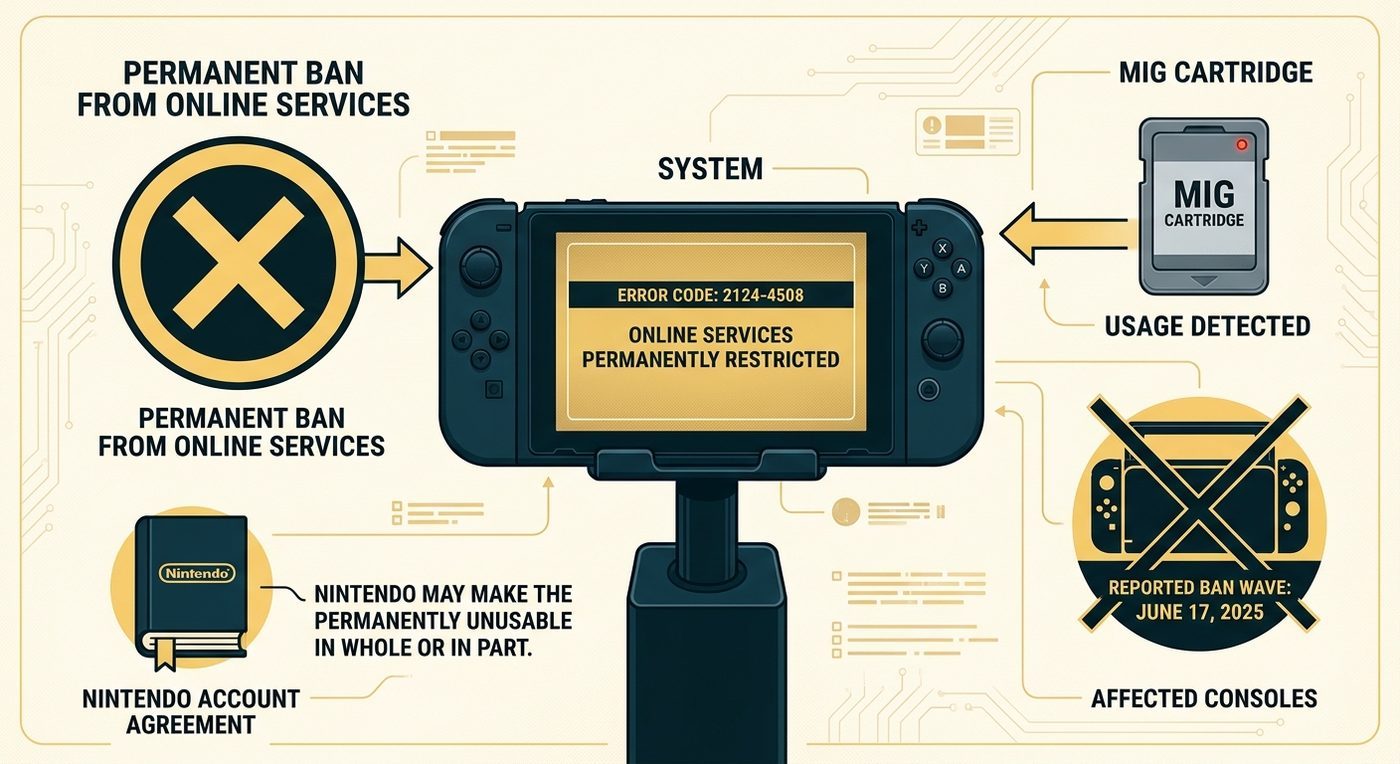
The Switch 2 launched in June 2025. Pocket Tactics reported on June 17, 2025 that Nintendo was banning consoles that used MIG cartridges, a type of backup device, and that many affected owners got error code 2124-4508 and a permanent ban from online services. The Nintendo account agreement says Nintendo may make the console "permanently unusable in whole or in part."
In July 2025 Procon-SP, the São Paulo office of Brazil's consumer protection body, called that clause "abusive" and asked Nintendo to change the wording. Nintendo said it would review the complaint. The same month the FBI and the Dutch agency FIOD seized the piracy site NSW2U.com and seven others, citing 3.2 million downloads between February 28 and May 28, 2025 and estimating more than 170 million dollars in harm.
ns2jb
On October 22, 2026, pepsipu released ns2jb. The original Switch went about a year before its first public exploit, and the Switch 2 took about sixteen months. As of October 23 I found no official statement from Nintendo.
Where Nintendo drew the line
The question the courts asked
In the Game Genie case the Ninth Circuit asked whether the device took the place of buying the game and found that it didn't, since buyers still needed the original. In London the importer's argument that R4 cards could run homebrew didn't save it. The court in Catania asked whether an R4 could run copyrighted code by itself, and decided in 2016 that it couldn't. Atari lost on the lie, and the judges still wrote that reverse engineering can be fair use. The Nintendo lawyer's line about Bowser says the same thing from Nintendo's side: purchases are what keeps the company going.
What Nintendo left alone
I found no Nintendo lawsuit against the Wii team, smealum, Temkin or fail0verflow. Those groups published free tools for homebrew, and some of them said outright that they were against piracy. Nintendo's response was updates, a factory fix for the Switch chip and, after the 3DS, a bug bounty that paid researchers up to 20,000 dollars.
What Nintendo went after
The lawsuits went to people who sold or distributed something that could skip paying: Bung and the retailers of the Doctor V64, the importers and sellers of R4 cards, Team Xecuter, and the makers of an emulator that took in about 30,000 dollars a month on Patreon and let people play a game early. Nintendo also bans owners of Switch 2 consoles that use backup cartridges. I pay for my games, so those cases read differently to me than the ones where someone wanted to see what was inside a console.
| Case | Year | Did it let people skip paying? | What Nintendo did | Result |
|---|---|---|---|---|
| NES lock chip | 1988 | Atari wanted to publish without Nintendo's terms | Sued, won an injunction | Atari barred from NES games, settled in 1994 |
| Game Genie | 1990 | No, buyers still needed the game | Won an injunction first | Lost at trial and owed Galoob 15 million dollars |
| Doctor V64 | 1997 | Yes, it copied games | Sued, customs, retailers | Bung closed in 2000 and came back as Mr. Flash |
| R4 | 2007 | Yes, it ran copied games and homebrew | Raids and lawsuits in many countries | Banned in many places, clones remain |
| Wii | 2007 and 2008 | The team says it opposed piracy | Update 3.3 and later patches | Group became fail0verflow |
| 3DS | 2014 | Homebrew only, according to its author | Patches, then a bug bounty | Patched, game sold out for a while |
| Switch | 2018 | Free tools, plus the paid SX OS | New hardware from mid 2018 | Older consoles stay open |
| Team Xecuter | 2020 | Yes, prosecutors said 65 million dollars in losses | Criminal and civil cases | Bowser jailed and in debt, Louarn free |
| Emulators | 2024 | Nintendo said yes, a game played before release | Lawsuit and an agreement | Both ended |
| Switch 2 | 2026 | Not stated in the write-up | No statement found by Oct 23 | Still open |
What this means for ns2jb
The ns2jb write-up talks about homebrew, mods, save backups and research and doesn't address piracy. That puts it next to the Wii team and smealum, and those cases ended in patches. Nintendo's own agreement lets it disable a device that bypasses its protections, and it has already banned Switch 2 owners over backup cartridges. If ns2jb turns into something people sell, or into a way to play games without buying them, the earlier cases suggest the lawsuits will follow. If it stays a research project, a patch looks more likely. As of October 23 Nintendo hasn't said which.
Sources
Wikipedia pages were a starting point and were cross-checked against the other sources where I could.
- Popular Science (and MIT Press Reader), "How Nintendo bled Atari Games to death"
- Atari Games Corp. v. Nintendo of America Inc., 975 F.2d 832 (Fed. Cir. 1992), as summarized on Wikipedia
- Lewis Galoob Toys, Inc. v. Nintendo of America, Inc., 964 F.2d 965 (9th Cir. 1992), as summarized on Wikipedia
- Tedium, "The Game Genie Generation" (2015) and the Codemasters and Camerica history (2018)
- UPI, "Nintendo Sues HK Company," November 21, 1997; Wikipedia, "Bung Enterprises" and "Doctor V64"
- TechRadar, "Nintendo details the R4DS piracy case" (2008); Wikipedia, "R4 cartridge"
- WiiBrew, "Team Twiizers" and Wii homebrew history; Engadget, June 18, 2008; Slashdot, June 18, 2008; Wikipedia, "Hector Martin (hacker)"
- TechCrunch, November 20, 2014; Wikipedia, "Cubic Ninja"; TechCrunch, December 8, 2016 and Ubergizmo, April 12, 2017, on Nintendo's bug bounty
- Kotaku, January 7, 2017, on the NES Classic
- BleepingComputer and GameRevolution, April 24, 2018, on Fusée Gelée and ShofEL2; FNAC L'Eclaireur, July 13, 2018
- U.S. Department of Justice press release on Gary Bowser's sentencing, February 10, 2022; Wikipedia, "Team Xecuter"; Dark Reading; Game World Observer; Mezha, February 3, 2024
- MobileSyrup, March 4, 2024, on Yuzu; Video Games Chronicle, October 2, 2024, on Ryujinx
- Pocket Tactics, June 17, 2025; Wccftech, July 3, 2025; Gfinity Esports, July 14, 2025
- Part 1 of this series, "The Switch 2 got jailbroken. People have been opening Nintendo hardware for decades," and the ns2jb write-up by pepsipu